

You may be aware that I like jazz. I used to host a jazz radio programme, I once co-owned a jazz record label, and I have a lot of jazz records. But other than those times I’ve been able to squeeze it into my research (specialist music radio – including jazz; music on the internet – including jazz; that sort of thing.) jazz hasn’t been a significantly large part of my university work.
However, recently I was invited to be part of a project that was bidding for funds to specifically research jazz in Europe. I’m part of a team that includes cultural theorists, musicologists and actual musicians whose work focuses predominantly – if not exclusively – on jazz.
The bid was successful – and the project buys out the equivalent of a day a week of my time for the next three years to focus on (mostly Northern) European jazz. I’m going to have to go to jazz festivals in Denmark, Norway, the Netherlands, Austria, the UK and beyond, listen to lots of jazz music and have long conversations with people about jazz. You can imagine how upset I am about that.
The project is called Rhythm Changes. My bit, you may have guessed, is about where all that intersects with the internet.
Researching the researchers
There are several parallel research activities that are going on in different places as a part of this larger project. Someone’s looking at festivals and audiences. Someone’s looking at performance and education. Someone’s looking at the role of politics and state support in jazz. Someone’s looking at national identity. That sort of thing.
My bit is to connect with all of those projects and do two things. First, explore how the subject of that research can use (or does currently use) the online environment. Second, explore what happens when the process of doing that research is captured, put online and opened up to a wider community of scholars, jazz enthusiasts and other interested parties.
To be fair, it’s the least clearly defined area of research, and the least straightforward to explain. It’s experimental stuff and some of the researchers are, if not actually reluctant, then cautious.
Meet the team
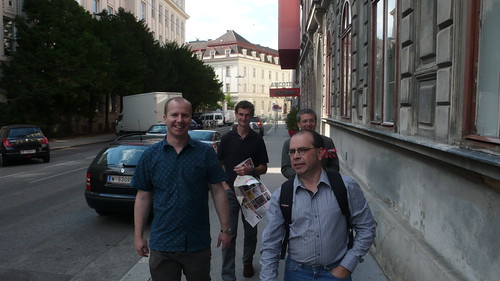
Tony, Nick, George, Walter and I explore the town
I know some of these people from conferences (or their books) over the years, and they’re some pretty heavy-hitting jazz academics. I have a fair bit to prove here, and I do feel a bit of an outsider in this mix – at least on the research front. There’s a core team of about nine of us – and the project will draw in a handful more for different bits and pieces.
Socially, of course, they’re all brilliant and fun people and we’re already getting on very well. It’s been great to get to spend some time with them, meet them all properly and get to work on our joint venture.
It’s an exciting project and I’m really looking forward to getting started. Today, our team leader is giving a presentation at the conference where all of the different HERA-funded projects announce what it is they’ll be doing with all the money they’ve been given.
The only projects I’m aware of are our jazz one – and the one about medieval manuscripts.
If you want to learn more about the Rhythm Changes project and the people involved, there’s already a website up and running here. Flip video cameras have been distributed to members of the team – and there will be blogging.
