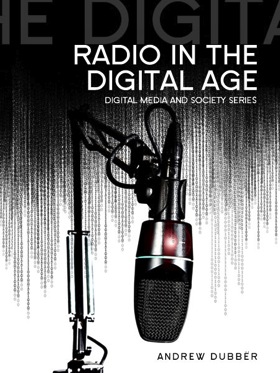
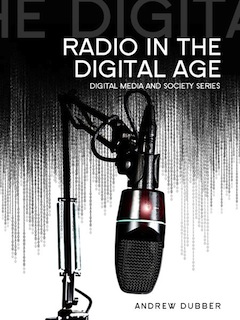
For the past few weeks, I’ve been working with a copy editor by the name of Manuela on preparing my Radio in the Digital Age book for print.
She’s been brilliant – making suggestions, corrections and alterations – and even adding additional knowledge and nuance in some areas that allowed me to expand some sections and go a little deeper.
I like to think I’m reasonably competent when it comes to spelling, grammar and punctuation. In fact, I’m a complete amateur. Manuela’s an artist when it comes to sentence structure and a scientist when it comes to understanding how the language really works.
I had no idea how deep that sort of expertise can go.
All in all, it’s been a really positive experience, conducted entirely via email and in comments on Word documents. We’ve never actually met.
Today I sent off the last bit of information she needed: the page numbers of a published book chapter in Spanish for which I only had a draft pre-translation English copy. Now that we have that, the book is complete and it’s off to press.
It’s great to be able to cross such a major project off my list. There is now nothing more I can do to change or improve it. I’ll simply have to wait and see it when it’s ready.
I’ve put out ebooks before, of course, and I’ve co-authored texts and contributed chapters to books that have been published by Sage, Longman and Routledge – but this is my first sole-authored, traditionally published book – so I’m quite excited about that aspect of it.
I have several other book projects in the pipeline. It’s been an interesting process going through this one from start to finish, and there are certainly some things I’ll do differently next time. But now that it’s done – it definitely feels like something I can do again.
So that’s encouraging.
Here’s some more about my books, if you’re interested.
I decided to stay on at Music Tech Fest after my presentation yesterday, and ended up joining in with the hack challenges. There were plenty that I had nothing to contribute to, as I can’t write code or programme in any way – but one of the hack challenges caught my attention: “reinvent music radio”.
In fact, the brief was actually posed as follows:
Radio is crucial to the music industry. It promotes music to the masses and largely determines the taste of the public. The problem is that the channel to make and promote music is controlled by a few large stations. Can you develop an alternative to radio that allows independent labels to promote their music to the public?
I asked if anyone in the room was keen to work on this, and had no response. Most people wanted to invent new musical instruments, design a “3D playlist”, create a software oscillator, build a hardware drum trigger, hack the robot bartender – that sort of thing. Sexier projects where you get to make things, in other words.
However, once I finally decided to tackle the radio problem myself, I was quickly joined by a designer by the name of Jedediah.
Between us, by about 2am, we had come up with the core concepts for RADIATR: a mobile platform that aims to solve some of the problems discussed in the hack challenge above. Here’s the document I wrote, with some of Jed’s mockups in the mix.
Later today, I’m giving a presentation that outlines some of the key ideas. It’s not perfect, of course – it was created in less than 12 hours in an all-night brainstorming and development session fuelled by junk food and Red Bull (perfect hacker sustenance, apparently…), but I think there are some interesting concepts in here.
Here are the slides from this evening’s presentation. There are prizes at stake.
Interested to hear your thoughts. Whether we end up doing something with this remains to be seen – but I think we could stand to kick it around a bit more before we abandon it. I may be utterly sleep deprived, but I feel like there’s potentially something worthwhile in here somewhere…
I’m giving an academic conference paper tomorrow at the Rhythm Changes jazz cultures research conference at Media City in Salford. My presentation’s centred around the Auckland jazz scene in the mid to late 1990s.
There are some interesting aspects to that scene: the cross-pollination between local hip hop and jazz, the influx of Australian musicians, the jam sessions at Manifesto wine bar, the radio shows, the clubs and DJs, the records that got released, and lots more besides.
The bit that I find fascinating – and it’s something I’ll talk about in my paper – is that all of these things were enabled and supported by a whole range of factors that have little if anything to do with music production, distribution and consumption cultures.
For instance, after the financial crash in the late 1980s, Auckland inner city office space vacancy rose from just 3% to over 25%, prompting a desire to fill those spaces with residential tenants for the first time. The influx of residents coincided with a rise of cafe culture in the CBD, the widespread adoption of the world wide web, the gentrification of the inner-city suburbs and other demographic shifts in Auckland’s population spread.
At the same time, radio (both public and private) was undergoing profound change, altering its relationship with both jazz and local music; and international movements such as Acid Jazz and Trip Hop were having an impact – as were international visitors, including Gilles Peterson, Massive Attack and Roy the Roach.
Young players were returning from formal jazz education in the USA at a time when the neo-classical agenda was almost at its peak, and they were dressing in suits and playing in art galleries – as well as taking this revisionist strain of music heritage into high schools. But these same players were, by night, collaborating with funk drummers, rappers, DJs and electronic musicians, guesting on local pop records and performing in multiple different combinations outside cafes, in parks and in bars.
CD sales – especially those that were about replacing existing vinyl collections – had started to hit their peak and the prices had begun to drop. So a classic Miles Davis record would sit on the shelf at Marbeck’s Records for a third of the price of a recent local release.
At the same time as the Auckland inner city jazz scene, as perhaps typified by Nathan Haines circa the Shift Left album, Sydney’s Jazzgroove movement was underway. Some of the artists visited New Zealand at the right time to intersect with it, and were exposed to some of the local conditions and frameworks. But what happened in Sydney was very, very different – and the music that resulted out of those two cultural projects was markedly so.
My point – and I do have one – is that these things are messy. It’s complicated. And so in a way, the Auckland example is entirely unique and unreplicable. And in another sense, it’s completely universal. These things are very different for all sorts of reasons. There’s never just one.
Looking forward to telling this story, drawing conclusions and maybe playing a little bit of kiwi music along the way.
I’ve had several interesting lunchtime meetings today (though only one lunch).
For my first meeting, I sat down with my teaching colleagues Sam Coley (left) and Andy Martindale to talk about the direction of our Music Programming undergraduate module.
It’s part of the radio degree, but it’s also something other Media students can choose as an option. It deals with two main things: specialist music shows and radio station formats.
The course explores how those two things work, how music makes meaning for people, and how putting music together in order constructs audiences and reflects scenes and cultures. It’s affectionately referred to as Mixtapes 101.
Students learn not only what makes music ‘work’ in different contexts and as a piece of media communication, but also the mechanics and techniques of format radio. Of course, these days, the applications of constructing musical texts over time applies right across media – particularly in digital media contexts.
We’re looking at putting together an online resource for this sort of thing.
Incidentally, Sam’s documentary celebrating the 30th anniversary of Bowie’s Let’s Dance is on Absolute Radio this Sunday.
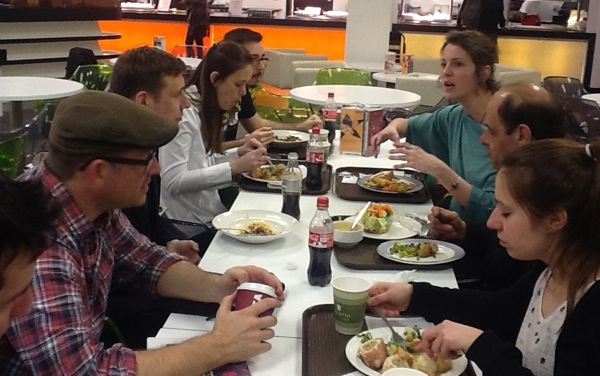
The second meeting was with a bunch of people who run a Brazilian newspaper in London called The Brazilian Post. That’s them pictured above. They “enjoyed” our university canteen food while we chatted. I, er… “wasn’t hungry”.
They want to interview me about my research and the documentary film I’m going to be making about solidarity economy in the independent music sector in Brazil. They knew a lot about Fora do Eixo, the group I’m working with out there, and had some really interesting insights into the way in which FDE have set up their own political and economic framework outside of the way that traditional economics works.
Solidarity economy is sometimes referred to as “friendly capitalism” and one of the newspaper people called it “the most important movement in the world today”. So I might be onto something…
One of the University marketing people and someone from international recruitment were also there. Must have said something right, because I was offered another trip over to Brazil in September to do some recruitment stuff for BCU too. Not going to say no to that.
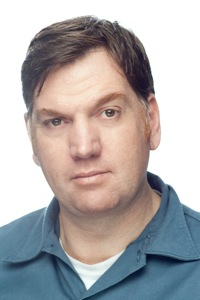
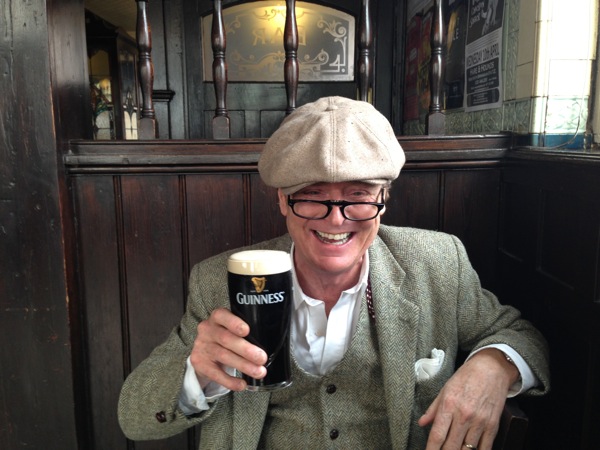
And my last meeting was with my friend Brian, who’s the sax player in UB40. We had a whole bunch of stuff to talk about, new and interesting projects on the horizon – and, finally, actual lunch too. It was great to catch up. We used to DJ together pretty much every week for a while there, but haven’t seen each other for a few months.
He’s asked me to be on a non-executive board he’s putting together for his latest project, and I’ve asked him to be involved in a new online venture I’m helping out with – and we worked out some interesting ways of getting students involved (and paid) along the way.
So… I may have started at noon and ended at 4pm, but I managed to get some really good work done over that extended lunch break. More meetings should happen that way.
That’s an orange juice Brian’s holding in that picture, by the way. We were all business.
I finally received feedback on my book Radio in the Digital Age from the external reviewers. The publisher has sent me the comments and suggestions from anonymous peers, whose advice can range from minor suggestions through to a complete rewrite – or even “don’t publish”.
This is the bit that academic authors dread. Or at least, I assume so. That’s my experience anyway.
After having spent all that time and mental energy putting together what I imagined to be a coherent document, here was the point at which a couple of people could look at it and say “not worthy”.
Thankfully, that was not the case. I have some work to do – a little bit of reordering at the beginning and end, a few extra caveats and citations to ensure that my assertions are entirely justified, and one or two clarifications, and that’s really about it. A leisurely month or so tweaking, re-reading, and refining – and all’s well.
One of the reviewers called it “readable, thoughtful and knowledgeable”, which are all good things to be. The other reviewer remarked upon my tradition-breaking approach to the topic which was “unusual and welcome”. Feedback also included the phrases “carefully nuanced”, “unusually engaging”, “concise, yet comprehensive” and “a sophisticated critical evaluation”. So that’s all lovely and positive.
But then I noticed the words “on target for publication early 2014” and my heart sank. The agreement with the publisher had been for a 2013 release. There’s a university research evaluation called the REF coming up next year, and the amount of funding we get allocated to continue to do research depends entirely on the outputs we submit.
Publications from 2013 are counted. Those from 2014 aren’t.
In short – I need this out. Otherwise, as far as my job is concerned, I almost may as well not have bothered writing it.
A frantic to and fro with the publisher, and it was agreed that if I can make the suggested changes and proofing within the next two weeks (TWO WEEKS?!) then they should be able to get it out before the end of the year. No promises, mind…
I'm an author of books about technology, culture, music and radio. I'm also an award-winning broadcaster and filmmaker, a public speaker and lecturer, record producer and festival director. I am closely following developments in emerging technologies and the cultures and ethics surrounding them, and my projects typically focus on issues of justice, inclusion, and sustainability.
Most of my work involves surrounding myself with incredibly smart and talented people who would have no other reason to ever be in the same room as each other. That's when amazing things happen.
I tend to talk a lot about music (often jazz-adjacent and particularly on vinyl, but also playlists and mixtapes). I'm enthusiastic about food and cooking, the intersection of art and science, new technologies, vintage technologies, education, social progress, silence, innovation, narrative, data commons, culture, sound art and the spoken word. This blog will continue to reflect those diverse and shifting enthusiasms. I may also digress.
I'm from Tāmaki Makaurau / Auckland in Aotearoa New Zealand, I have Scottish ancestry, I've spent a decade in the south of Birmingham UK, and another in a forest in the north of Sweden.
Contains information related to marketing campaigns of the user. These are shared with Google AdWords / Google Ads when the Google Ads and Google Analytics accounts are linked together.
90 days
__utma
ID used to identify users and sessions
2 years after last activity
__utmt
Used to monitor number of Google Analytics server requests
10 minutes
__utmb
Used to distinguish new sessions and visits. This cookie is set when the GA.js javascript library is loaded and there is no existing __utmb cookie. The cookie is updated every time data is sent to the Google Analytics server.
30 minutes after last activity
__utmc
Used only with old Urchin versions of Google Analytics and not with GA.js. Was used to distinguish between new sessions and visits at the end of a session.
End of session (browser)
__utmz
Contains information about the traffic source or campaign that directed user to the website. The cookie is set when the GA.js javascript is loaded and updated when data is sent to the Google Anaytics server
6 months after last activity
__utmv
Contains custom information set by the web developer via the _setCustomVar method in Google Analytics. This cookie is updated every time new data is sent to the Google Analytics server.
2 years after last activity
__utmx
Used to determine whether a user is included in an A / B or Multivariate test.
18 months
_ga
ID used to identify users
2 years
_gali
Used by Google Analytics to determine which links on a page are being clicked
30 seconds
_ga_
ID used to identify users
2 years
_gid
ID used to identify users for 24 hours after last activity
24 hours
_gat
Used to monitor number of Google Analytics server requests when using Google Tag Manager

 For the past few weeks, I’ve been working with a copy editor by the name of Manuela on preparing my Radio in the Digital Age book for print.
 I decided to stay on at
 I’ve had several interesting lunchtime meetings today (though only one lunch).
 I finally received feedback on my book
