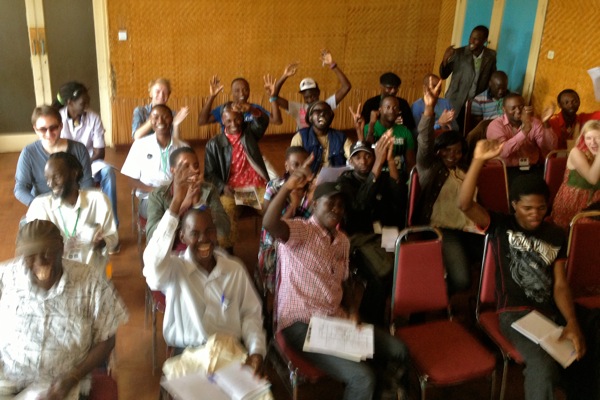
It was, it has to be said, a very different presentation about music marketing than the one I gave at the Cheltenham Jazz Festival the previous weekend – though I guess some of the key principles remained the same.
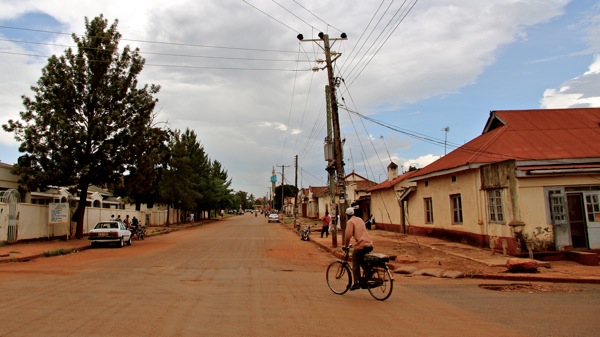
Chances are the vast majority of African musicians you’ve actually heard of are West African musicians. In East Africa, generally speaking, there’s very little in the way of infrastructure, not much happening in the way of performance opportunities and hardly anything you could call an independent music industry.
There are, of course, some fairly big name pop stars in Uganda, and indeed, one of them played out the back of our hotel at deafening volumes until 2am on Saturday night – which seems an odd thing for a hotel to allow. But in general, there’s not a great deal going on for most people.
If you want to start a career as a musician or you want to be a music industry worker in Uganda, then your options are fairly limited in the grand scheme of things.
The big tip-off for me was the complete lack of record stores. This is the first place I’ve ever been where vinyl shopping was simply not an option. Nobody owns record players, and nobody sells records. Seems it’s always been this way. You can buy a CD – burned to blank disc according to your specifications from an old PC in a small roadside store. But other than this – no music retail. And not much else in the way of music business either.
However, there are, of course, musicians. Great musicians. Some good producers too. A couple of really wonderful venues.
Here’s a brief sample of some of the music we encountered or caused to happen.
There just hasn’t been any real consolidation of the pockets of activity happening around East Africa or any clear route to market. So one of the things that Un-Convention has been involved with here for the past year has been the establishment of the Bayimba Co-op, which brings musicians and other artists together to share knowledge and contacts – the idea being that collaboration provides an opportunity to build sustainable careers within the arts for local people.
To see musicians working together towards the creation of a whole new industry, built on principles of cooperation rather than competition has been fantastic to see, and it’s an amazing place to be – for all sorts of reasons.
It’s my first time in Africa – let alone Uganda – and it’s been a fantastic introduction.
I’ve been very busy the whole time, of course. I swam in the Nile, hiked alongside waterfalls, watched some of the most incredible percussionists I’ve ever seen, danced to one of the best live reggae bands I’ve heard, won hundreds of thousands of shillings at the roulette table (nearly £30), and saw some amazing animals.
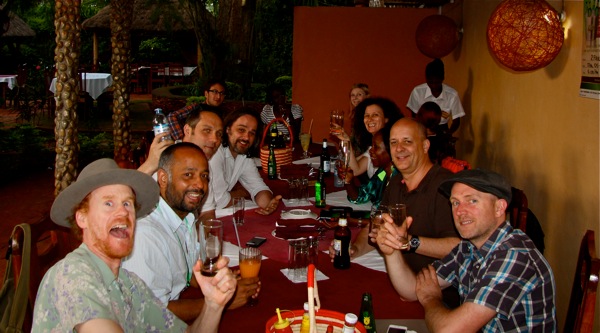
I was there with a fantastic bunch of people and have many, many stories to tell…
I also took about 500 photos, which you’re welcome to wade through, if you feel so inclined…
I’ve been looking at music business figures in the news today. I really shouldn’t.
The problem is that macro-economics tell a story without meaning. There is no useful knowledge that can be gleaned from Online music licensing revenues pass radio for first time. Why? Because the fortunes of a very few artists skew the results every single time.
So focusing on online music licensing as a business strategy only becomes a reasonable response if you’re Ed Sheeran, Adele, Coldplay or Mumford and Sons. It’s not just unhelpful information, it’s scarcely even descriptive.
Take, for instance, a headline like “UK album sales up on previous year”. That might simply mean “Adele released a record recently”. In aggregate, it gives a false picture.
Or what about the idea that physical sales for music are down? Other than in aggregate, maybe, it’s nonsense. It might say something about the fortunes of a sector, but it’s no basis for strategy for an individual act.
What if the sales of physical products are actually UP for the top half a dozen acts, significantly DOWN for the next 100 artists or so, and UP for pretty much everyone else (the so-called ‘long tail’)? The fact that those 100 next-tier artists are collectively so significant financially means that the overall aggregate is down.
My point: it adds meaning to the results when you start to slice the data up. Even only a little bit. Even with an arbitrary, rhetorical number like 100.
Coincidentally, I also received a press release from the PRS this morning, claiming that more money had been paid out to their members over the last year than ever before. I sent back an email asking if that information could be subdivided so we could see the relative growth between the top 20% and the bottom 80%. They declined.
But without even very simple analytical dividing tools like that, aggregation is utterly meaningless as a method of understanding the music business. If one artist (or five, or a hundred) can utterly skew the overall results, then a total is empty information.
And that’s what nearly every ‘state of the music business’ report is based on.
I’ve been back in New Zealand this past week speaking at an event called Going Global. It’s been great to spend time in Auckland, Wellington and Christchurch with some really lovely people, talk about music online, see a bunch of bands and, where possible, catch up with some friends.
A bit of a whirlwind tour, unfortunately, but I have managed to do some of the things on my must-do list – including spending some time (and money) at Conch Records, seeing a bit of each city (and, in the case of Christchurch, some of the incredible scenery of the surrounding areas), and doing some of the radio and press interviews, I said I’d do while I’m here.
I absolutely, positively loved Wellington – and it more than lived up to its windy reputation (in fact, we were lucky to get out, as they closed the airport not long after we left due to extreme weather), and going to Auckland felt like coming home – even more than I thought it would. Christchurch has been bittersweet of course. It’s lovely, but it’s heartbreaking to see so much devastation.
I don’t know Christchurch nearly as well as I’d like to – and now I feel like there’s a large part of it I’ve missed out on and will never get a chance to experience. But the overwhelming feeling here seems to be one of optimism and normality. Absolutely loved the shopping mall made of shipping containers, and hope that stays around as a landmark and a testament to the people here. Inspiring stuff.
I’ve been running the MA in Music Industries (as well as the MA in Music Radio) this year at Birmingham City University. We had our first intake in February, and things really kicked in for the September intake.
From September we’ve also been offering the course as a distance learning programme, which is great because it means that people from anywhere in the world can do the degree without having to move to the UK (or, if they live in the UK, without having to move to Birmingham – though why wouldn’t you want to?).
We are in week eight of the program at the moment, and I have to say that I’m really pleased with how it’s going – particularly the online component, which has been so helpful that the students who are doing the course with attendance are also making use of the materials online to supplement what they’re doing.
The students are also running a blog together, in which they talk about their research, their reflections upon the readings that they’ve been doing, and their critiques of happenings within the music industries.
The point of the blog is to invite others from outside the course – and particularly, within the industry – to get involved, comment, and add their thoughts and reflections as well. Hopefully, in return, the work that the students produce will provide helpful reflection and interesting discussion points for the music industries at large. Go have a look.
One of the most useful things we’ve been using, though, is Planzai.
I'm an author of books about technology, culture, music and radio. I'm also an award-winning broadcaster and filmmaker, a public speaker and lecturer, record producer and festival director. I am closely following developments in emerging technologies and the cultures and ethics surrounding them, and my projects typically focus on issues of justice, inclusion, and sustainability.
Most of my work involves surrounding myself with incredibly smart and talented people who would have no other reason to ever be in the same room as each other. That's when amazing things happen.
I tend to talk a lot about music (often jazz-adjacent and particularly on vinyl, but also playlists and mixtapes). I'm enthusiastic about food and cooking, the intersection of art and science, new technologies, vintage technologies, education, social progress, silence, innovation, narrative, data commons, culture, sound art and the spoken word. This blog will continue to reflect those diverse and shifting enthusiasms. I may also digress.
I'm from Tāmaki Makaurau / Auckland in Aotearoa New Zealand, I have Scottish ancestry, I've spent a decade in the south of Birmingham UK, and another in a forest in the north of Sweden.
Contains information related to marketing campaigns of the user. These are shared with Google AdWords / Google Ads when the Google Ads and Google Analytics accounts are linked together.
90 days
__utma
ID used to identify users and sessions
2 years after last activity
__utmt
Used to monitor number of Google Analytics server requests
10 minutes
__utmb
Used to distinguish new sessions and visits. This cookie is set when the GA.js javascript library is loaded and there is no existing __utmb cookie. The cookie is updated every time data is sent to the Google Analytics server.
30 minutes after last activity
__utmc
Used only with old Urchin versions of Google Analytics and not with GA.js. Was used to distinguish between new sessions and visits at the end of a session.
End of session (browser)
__utmz
Contains information about the traffic source or campaign that directed user to the website. The cookie is set when the GA.js javascript is loaded and updated when data is sent to the Google Anaytics server
6 months after last activity
__utmv
Contains custom information set by the web developer via the _setCustomVar method in Google Analytics. This cookie is updated every time new data is sent to the Google Analytics server.
2 years after last activity
__utmx
Used to determine whether a user is included in an A / B or Multivariate test.
18 months
_ga
ID used to identify users
2 years
_gali
Used by Google Analytics to determine which links on a page are being clicked
30 seconds
_ga_
ID used to identify users
2 years
_gid
ID used to identify users for 24 hours after last activity
24 hours
_gat
Used to monitor number of Google Analytics server requests when using Google Tag Manager