Teaching machines to make art
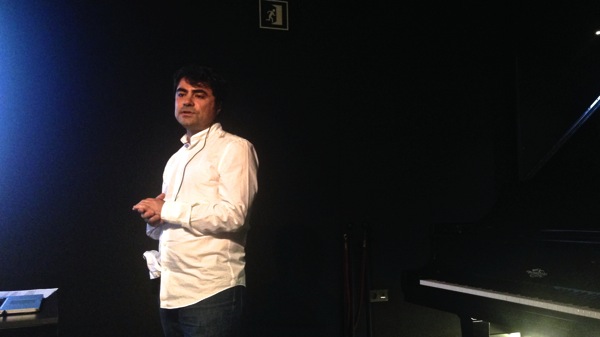
Much of yesterday was spent inside the Málaga Interactive Museum of Music, where I was part of a day-long seminar called 0music – about what it means that computers can now compose music.
The seminar came at the end of a four year research project by Professor Francisco Vico and his team, during which time they had not only created computer software that was capable of composing pieces of music, but had also used that software to create probably the biggest repository of free and open source music in the world.
I was one of five presenters given an hour to explore what exactly that might mean for culture, for society and for the science of music.
It should be said right at the outset that the music that Iamus, the computer composer, has created is a particular kind of contemporary classical music that will cause little or no concern to composers of popular songs. But what’s interesting is that these thousands upon thousands of compositions provide a tool, rather than a replacement, for composers who do work in that area.
And – moreover – it would appear to pass, if such a thing exists, a Turing test for music. Had I not known that ‘Hello World!’ was not written by a human, I for one would not have been able to guess.
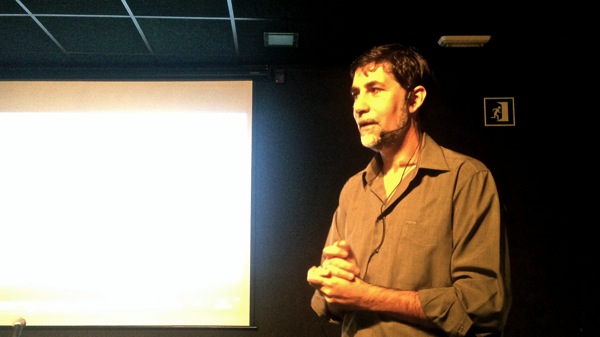
The presenters represented a cross-section of approaches to this idea: a computer scientist working at the intersection of artificial intelligence and music; a science writer who has written a book about the human need for music; a communication professor with an interest in the relationship between humans and machines throughout the history of music, a composer and pianist who uses scientific principles and computation as the basis for his work – and me: someone who thinks about the relationship between media technologies, music and culture.
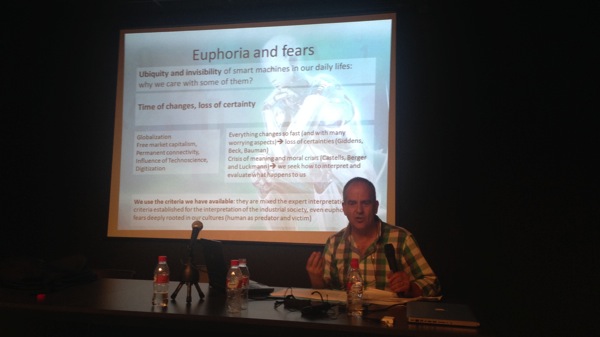
The different perspectives were interesting – not least because of the overall optimistic tone about the prospect for computer-composed (and not just computer-generated) music.
We discussed the fact that the idea of humans using machines and algorithms to shortcut the process of music creation is hardly new – and that regardless of the level of autonomy of the artificial intelligence at work – what is being enhanced is the degree to which human beings can communicate through music.
But while this is clearly a landmark in the development of artificial intelligence in the area of music, I’m left with the idea that it would have been interesting to find out whether Iamus could have written a simple pop song, a house tune, or even some library music for commercial use. It seems that the rules in those areas of music are fairly straightforward – but that there are also some things that humans do intuitively that lift those forms beyond mere algorithm.
In fact, it may even be an indictment on Western classical music that so much of the intellectual heavy lifting of composition can be convincingly outsourced to a machine. There have been computer-generated Bach pastiches in the past that have been incredibly convincing – but only because of the rules and parameters that Bach himself adhered to in the creation of his music. But contemporary classical music, to most listeners, is at a level of abstraction that can make it difficult to locate the intention, the communicative content and the emotional essence of a piece.
Even so – to call what Iamus creates ‘art’ is contentious at the very least. Art suggests some sort of intentionality. Where the art happens for me is the point at which Gustavo takes the compositions and arranges them, edits them and performs them. How those pieces are used as acts of human communication are more interesting to me than the works themselves.
And yet, when you listen to ‘Hello World!’ and forget about the provenance of the composition, there is an unmistakably authentic musicality about it. Perhaps this comes from the fact that the piece is played by human musicians using traditional orchestral instruments – and we simply ascribe particular meanings to those sounds played in those ways – but I think it would be wrong to say that because of the way in which the music was made, it has no meaning.
Interestingly, one of the criticisms of the project that came out at the seminar yesterday was that the pieces that Iamus creates are not abstract enough. That a computer should be able to do things with music that humans won’t do: create works that only a 27-fingered pianist could play, perhaps. But I’d like to see it attempt simplicity.
That said – a really fascinating day – and given that it was one that included some very good tapas, a walk around a beautiful city, a successful bit of second hand record shopping, a siesta and a group of new friends, I’m calling it a success.