
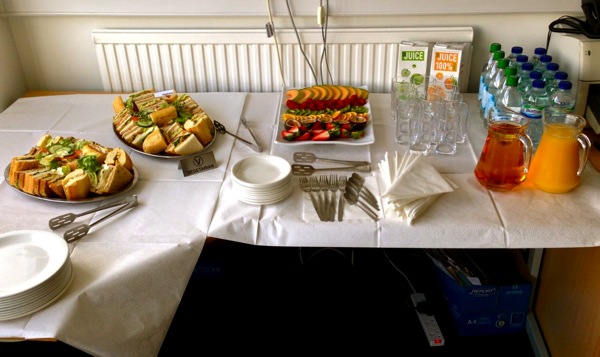
I went to a Professors and Readers lunch yesterday (and no I’m not putting any apostrophes in there). It was a small gathering in the (acting) Dean’s office in order to meet up, chat about things professorial and generally get a cross-faculty sense of who’s who and who does what.
You’d be surprised how rarely research academics in the same department – let alone the same faculty – cross paths. I think I see Tim Wall in Salford more often than I do in Birmingham, and our offices are separated by two flights of stairs. I hadn’t ever met two of the professors in the room – and I had only a passing acquaintance with the work of another.
As with so many of these sorts of things, we did a bit where we go around the table, everybody introduces themselves and talks about what they do. Unfortunately, as newest professor on the block, I was chosen to go first, so I didn’t get to take some of my cues from the other people there, which is always a helpful thing to do in terms of knowing what to say, what sort of language to use and so on.
As a result, I feel like I left some things out, spoke about some stuff that didn’t translate well outside of my discipline, or gave an incomplete picture of what it is I do. So I thought I’d have another go here.
Hi. I’m Andrew Dubber. I’m Professor of Music Industries Innovation.
I’m interested in three main things:
1) Independent music business and alternative music cultures online;
2) Innovation in independent music enterprise (which need not involve digital technologies); and
3) Music as a tool for social change.
I come at these things from a number of directions. I’m a Media Ecologist (with an interest in the concept of affordances borrowed from Cognitive Psychology, as well as the usual McLuhan stuff) in a Media Studies department with a strong Cultural Studies tradition, and I’m a member of the Centre for Media and Cultural Research. I’m also both a Radio Studies and Jazz Studies academic, though I should not be mistaken for a musicologist.
I have a non-traditional academic background, coming from fifteen years in the radio industry and having run an independent record label. I moved into teaching and then later research and a lot of my work is practice-based and experimental. I like to find things out by making and doing things, and I also focus on Knowledge Transfer / Knowledge Exchange activities, ensuring that the research I do has a useful and practical dimension to it that can be of benefit outside of academia – for instance, working with organisations and music businesses to help them do what they do better. And of course, my research informs the teaching I do as well.
I’ve written books on the music industries, I’ve just finished one about radio, and I am currently in the early planning stages of a book about independent jazz record labels.
I run an MA in Music Industries and an MA in Music Radio – both with attendance and by distance learning pathways – and I also supervise a handful of PhD students on a number of related subjects.
So – that’s my job.
The other people around the table did a whole range of interesting and diverse things, and most had been doing those things far longer than I’ve been doing any of the things I do.
Because we’re a Faculty of Performance, Media and English, there’s a lot of overlap between the sorts of things we’re interested in – from the performance of electronic music that uses obsolete computer technologies, to the history of modernism; from the study of jazz on radio in the first half of the 20th century to the linguistic analysis of the English language using the entirety of the internet rather than books as a source for text.
It was like being in half a dozen simultaneous episodes of In Our Time, only with sandwiches.
Shame I don’t eat bread.

And yes, I suddenly realise that this falls under the broad heading of ‘blogging as credentials’ more than it does ‘blogging as communication’ (as per my earlier categorisation). Sometimes anecdotes don’t serve exactly the purpose you intend them to.
But perhaps there’s a lesson here about having some clarity about what it is you actually do and what your job is for. That way you can focus on the stuff that supports that, and spend less time worrying about the stuff that gets in the way of that happening.
I’m a bit of a fan of the Pareto principle in that respect. It’s good to focus on the 20% of activity that gets you 80% of the results – and having some clearly articulated position about what it is you’re trying to achieve makes that 20% much more visible.
For me, having come up with this much improved encapsulation of what it is I do has been helpful. And hopefully others will find the same activity of use.
(…he said, trying to retrospectively justify wild inconsistency.)