I’m getting a lot of fresh air at the moment. It’s helping a lot. Every now and then, you need a bit of scenery and oxygen. As you may have picked up, I’m in Sweden. Actually, I’m further north than most people think of when they think of Sweden. I’m just outside of Umeå, in the Västerbotten region.
But I’m not in Sweden for my health. I’m working here. I’ve been meeting with some fantastic people at the University of Umeå to bring Music Tech Fest to Scandinavia.
If you haven’t heard of it, Umeå is currently Europe’s ‘Capital of Culture‘. That means there’s a lot of investment, a lot of optimism and a lot of fascinating interdisciplinary projects – many of which take place at the intersection of design, music, technology and art.
In other words – my kind of thing.
There’s also a rather cool Guitars museum – with the largest collection of electric guitars on the planet. They have rare Fender and Gibson guitars from the 50s that Fender and Gibson themselves don’t have.
The university has a new facility opening up soon called Sliperiet. It houses a range of innovative projects and businesses making art installations, feature films, new types of interactions and products, and – interestingly – projects that bring together music and technology.
The facilities here are incredible. Make anything you want from digital video to large structures of wood and steel. They can 3D print a car, for goodness sake.
Sliperiet will be the home of Music Tech Fest Scandinavia 2015.
I don’t seem to have taken a lot of photos of the city centre here. Or any, actually. It’s very nice – and there are cafés, record stores, cinemas, supermarkets and all the other things you need to run a city. Traffic is no problem whatsoever. There are even cycle lanes.
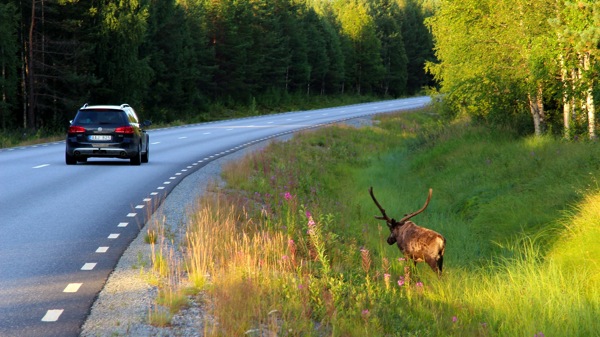
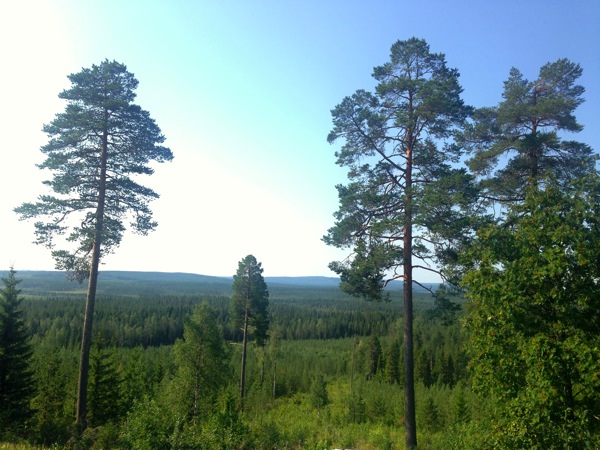
But there’s also an awful lot of nature here in Sweden. Bears, moose, reindeer, frogs, squirrels, and birds of many shapes and sizes. And it tends to be those things that I’ve been pointing my camera at. After all, this is not the sort of thing you see every day in Kings Heath, Birmingham.
More noticeably, from a nature perspective, Sweden appears to be basically a series of lakes and fjords loosely held together by pine forests. A trip on the Wilderness Way is strongly recommended if you get over this way. In fact, make a point of it.
Hiking’s a big thing here. So is fishing. Cycling, golf and hunting also seem to feature heavily on the ‘going outside’ agenda.
Swedes appear to like being outside rather a lot. I thought it might have been something to do with the fact that up here near the Arctic Circle, any bit of sunshine would be welcomed as an opportunity to leave the house, but apparently the whole going out into nature thing is a year-round experience. Even when it’s minus 30 outside. Those activities that require the surrounding area to be entirely frozen are also very popular.
I heard that the year-round average temperature here is 3 degrees. That’s not very warm. And yet, my experience here has been sunshine and temperatures in the mid to high 20s. One day, it reached over 30. I’m okay with that.
And of course – from a sightseeing perspective, what you can see when the sun does come out is worth seeing.
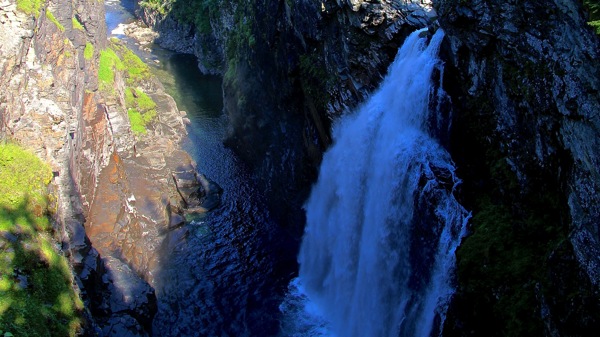
Imagine, for instance, visiting Niagra falls, and being the only person there. That’s a bit what going to Hällsingsåfallet is like.
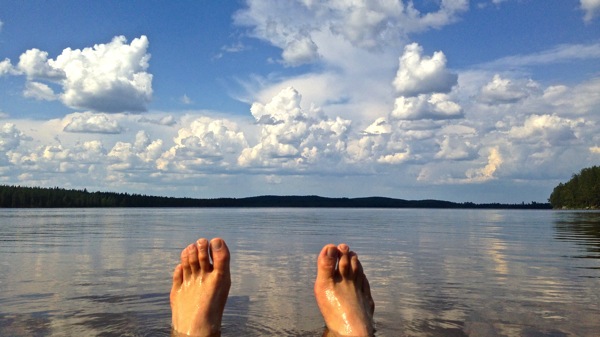
Imagine going swimming where the beach is in one country and the water in another. Did that a couple of days ago.
Imagine taking a stroll through a mature pine forest from the banks of a fjord to the edge of a lake just to get from your own house to have a cup of coffee at your friend’s house. That’s where I’m at right now. And I’m less than 15 minutes from the city centre.
Imagine sitting and writing a blog post at 10:30pm as the sun slowly starts to set outside. That’s what I’m doing.
I like it because it’s not what I’m used to. I like it because despite all of the work and the stress going on right now for all sorts of reasons – it feels like a holiday. I like the people and I like the place. I like the innovation, I like the optimism and I like the ambition here. I like the food, the attitude and just how damned civilised it all is here.
I love the forests and I love the lakes. Those are really special. I’m out of here after the weekend – but I’m definitely coming back. This is a magical place. Can’t wait to see it buried in snow.
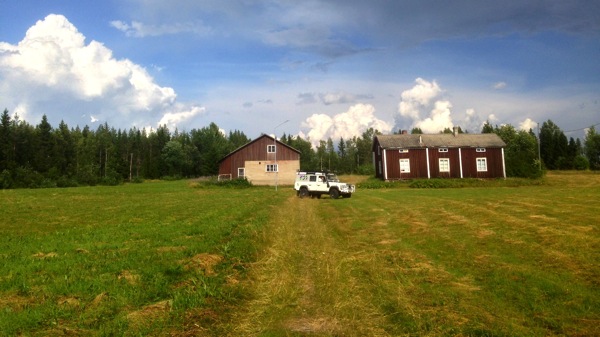
To the untrained eye, Floda 31 appears to be a series of about half a dozen old farmhouses and barns on a large plot of land overlooking a forest. In reality, it’s a multidisciplinary design research facility.
Birmingham-born Rich Holland and his Dutch partner Marije de Haas established it (and are still building it) in the last remaining wilderness of Europe, on the site of a farm in northern Sweden surrounded by incredible views of ancient spruce forests, just south of the arctic circle.
I’m staying here for a couple of days, relaxing, taking in some scenery and getting my head around the kind of innovation that can happen in a place like this – and it’s on a scale that’s much larger than anything I’ve come across.
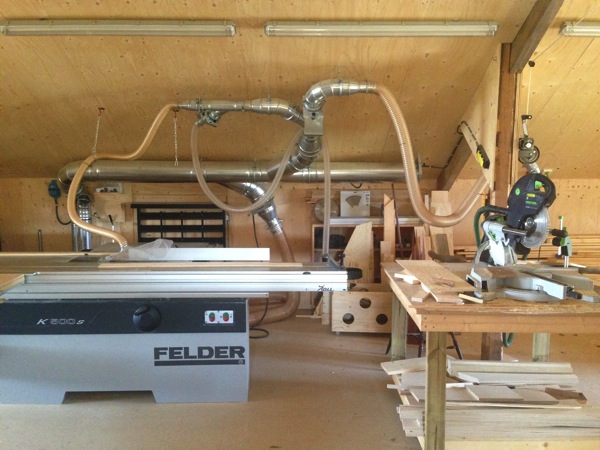
Pretty much anything that can be made, can be made here. The workshop contains everything you might need to build anything from a website to a skate park – from a feature film to an observatory to chart the transit of Venus.
The residencies held here bring together science, art, architecture, design and technology to explore ideas and themes – primarily around the concept of sustainability. All of the ideas and innovations created at Floda 31 are made available to the public under a Creative Commons licence.
The people here are smart, fun and interesting -and the scenery here is breathtaking. It’s a place I’d love to spend a bit more time.
We’ve been talking about putting together an event of some kind. Something that grows out of the Music Tech Fest, but extends it to bring together music and technology, art and architecture, design and innovation. It’d be great to hold some kind of residential event in this really beautiful part of the world.
We’re just kicking around concepts at this point – but something interesting could come of this. Watch this space.
In the meantime, it’s an amazing place to be – and so incredibly quiet. Except, that is, for the constant bouncing around of ideas, the sounds of cooking, laughing and the toddler playing in the corner.
Just had a lunch of freshly-caught pike from the adjacent river – followed by a swim in an enormous, pristine, and beautifully warm lake entirely surrounded by forest. I could get used to this sort of thing.
Not entirely sure I could get used to the other half of the year when it’s 20-odd degrees below zero and you could walk across this lake, but that’s another story.
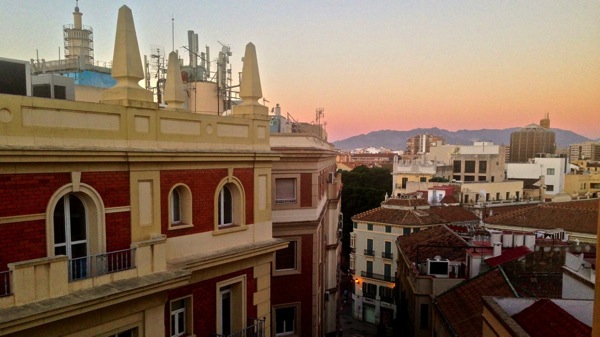
I deliberately woke up early to catch the sunrise in Málaga today. I’m not here for long, and I want to see a little bit of it, so I think a walk before breakfast might be in order. That view above is from my hotel room. You can smell the sea from here. It’s already warm and I can hear music, motor scooters and seagulls, despite being right in the city centre.
I’m here to do a presentation at a one-day symposium about computers in music. I’m not entirely sure how that happened, but I’m glad that it did.
My host is Francisco Vico, who for the last four years has been running a research project in which he has developed an artificial intelligence system that can compose music with no human intervention. That music has been performed by the London Symphony Orchestra, and has been recorded and professionally released.
As you might expect – a computer composer can be prolific. Iamus, the non-human intelligence behind the works, is about to release its second album. The first, which contains the contemporary classical work ‘Hello World!‘, was the first record solely composed by a computer programme and recorded by human musicians.
I’m here with UK science writer Philip Ball, whose book The Music Instinct is one of my favourite works on the subject – up there with Oliver Sacks’ Musicophilia.
There are just five speakers today, but they are from very different fields – ranging from respected composer Gustavo Díaz-Jerez to a media and cultural studies academic (that would be me). Our role here is to reflect on different aspects of what it means that computers can compose music. None of us, as far as I can tell, seem particularly averse to the idea.
Not that all music should be composed by artificial intelligence, of course – but that it can, and is being composed. I think that’s interesting, and I think it’s important that it’s happening – because that potentially changes our relationship with music yet again – in much the same way that the industrialisation of music production changes our relationship with it.
Our audience, however, might differ. For the most part, we’ll be talking today to a group of musicians from the Málaga Conservatory, and our brief is to be provocative. Not argumentative, necessarily – but provocative in the sense of challenging people to think in ways they ordinarily might not. I think I can manage that.
My presentation is about how music has fundamentally changed in terms of how we compose, produce, distribute and consume it with each major shift in the dominant media environment – from an oral society, to a print society to an age of digital media – and beyond. I started writing about that here on this blog a little while back, but I’ve since refined the idea somewhat – and this one-hour presentation today is my first chance to try the now slightly more elegant theory out in public.
Of course, it’ll have to be clear – and, since the presentation will be in English in a Spanish-speaking country, I’ll need to keep the pace significantly below my usual rapid-fire delivery – but I’m looking forward to presenting and defending my work, because this is what a lot of my research over the last decade has led up to – and there have been a number of recent ‘Eureka!’ moments that tie all the pieces together. And this reflection on the Melomics AI research project is the perfect opportunity to try these ideas out.
But first, I’m going to have a proper look at Málaga – as much as you can before breakfast, at any rate. And later today, I’m told there’s a very good second hand record store where I can pick up some flamenco music on vinyl. Because really – that’s the important bit.
This was going to be a tweet. But it ran a little long. So I started writing it as a Facebook post. That ran over as well. So instead – this status update has to be a blog post:
Got home late last night. Been right around the world and organised a couple of Music Tech Fest events in Wellington and Boston. More about them soon.
Also used the opportunity to visit Mum in hospital in Auckland, finally introduce Michela to the family in person, go hiking in national parks in the South Island, do a bit of wine tasting in Martinborough, climb clay cliffs in Omarama, pick up hitchhikers in Arthur’s Pass, watch fur seals from a boat in Milford Sound, scramble over rocks and under waterfalls, do an eye-watering amount of sightseeing, have lunch with Kim Dotcom in his mansion, eat tacos in San Francisco, meet with the lovely Ethan Diamond to discuss the future of Bandcamp, hang out with the incredible and synaesthetic LJ Rich from BBC Click, participate in a policy consultation meeting on the future of the Creative Industries at the European Commission in Luxembourg, go skiing for the first time, visit glaciers, dig through photos from my childhood, sit with some of the most gifted musicians I’ve ever met while they played their music, experience Virtual Reality using the Oculus Rift, help develop a music technology startup company, co-write a manifesto for the future of music technology research, eat a mind-boggling variety of incredible foods, sit in a volcanic hot spring in Iceland, have Skype tutorials and recruit new MA students, initiate new research projects, prepare a book proposal, partially write two book chapters, travel by every conceivable mode of transport, and make plans for more adventures just like this one.
Have never worked so hard, slept so little, handed out so many business cards, been so stressed, had so much fun, been in so many unlikely and surreal situations, seen so much amazing stuff, learned so many things so quickly, done so many things that scare me, met such a high concentration of truly brilliant minds, been treated so well, been so excited by ideas and projects, been involved with something that people seemed to appreciate so much, had so many adventures or taken so many photographs in my life.
I suspect that I can expect this level of intensity as a fact of life from here on out. I’m incredibly grateful and completely exhausted. No idea of time zones or even day of the week. Today is simply about unpacking, if I can manage that much…
As I write this, I’m on my way to Brazil to shoot a documentary film called ‘Occupy Music‘ (working title). It’s about Fora do Eixo – a cooperative and collaborative system for independent music that incorporates 200 cities, 30,000 artists, 6,000 shows a year and turns over a value of around US$44m just within Brazil.
This is a network of collectives that has its own political movement. It has its own university. It even has its own currency and bank, and it has built this infrastructure on the principles of collaboration, solidarity economy and open source platforms.
I’ll be visiting 12 cities in five weeks to conduct interviews and research further. I’m also producing a book and a compilation album featuring artists involved with the network.
I’ve actually been preparing for this moment for a few years, but now that it’s here, so far it just feels like sitting in a hot train to London, same as yesterday.
The documentary isn’t going to happen quickly. I’ll be travelling around Brazil for the next five weeks interviewing musicians, politicians, festival organisers, managers and others – as well getting some amazing shots of scenery, live music performances, and lots more I haven’t even thought of yet. And then I’m going back in November to get even more.
But I’m going to do some ‘behind the scenes’ video diary type stuff along the way and I’ll be posting it on the Occupy Music blog, which you’ll find at https://andrewdubber.com/brazil.
It was, it has to be said, a very different presentation about music marketing than the one I gave at the Cheltenham Jazz Festival the previous weekend – though I guess some of the key principles remained the same.
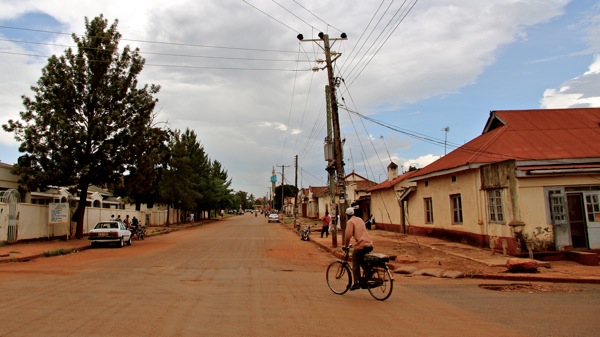
Chances are the vast majority of African musicians you’ve actually heard of are West African musicians. In East Africa, generally speaking, there’s very little in the way of infrastructure, not much happening in the way of performance opportunities and hardly anything you could call an independent music industry.
There are, of course, some fairly big name pop stars in Uganda, and indeed, one of them played out the back of our hotel at deafening volumes until 2am on Saturday night – which seems an odd thing for a hotel to allow. But in general, there’s not a great deal going on for most people.
If you want to start a career as a musician or you want to be a music industry worker in Uganda, then your options are fairly limited in the grand scheme of things.
The big tip-off for me was the complete lack of record stores. This is the first place I’ve ever been where vinyl shopping was simply not an option. Nobody owns record players, and nobody sells records. Seems it’s always been this way. You can buy a CD – burned to blank disc according to your specifications from an old PC in a small roadside store. But other than this – no music retail. And not much else in the way of music business either.
However, there are, of course, musicians. Great musicians. Some good producers too. A couple of really wonderful venues.
Here’s a brief sample of some of the music we encountered or caused to happen.
There just hasn’t been any real consolidation of the pockets of activity happening around East Africa or any clear route to market. So one of the things that Un-Convention has been involved with here for the past year has been the establishment of the Bayimba Co-op, which brings musicians and other artists together to share knowledge and contacts – the idea being that collaboration provides an opportunity to build sustainable careers within the arts for local people.
To see musicians working together towards the creation of a whole new industry, built on principles of cooperation rather than competition has been fantastic to see, and it’s an amazing place to be – for all sorts of reasons.
It’s my first time in Africa – let alone Uganda – and it’s been a fantastic introduction.
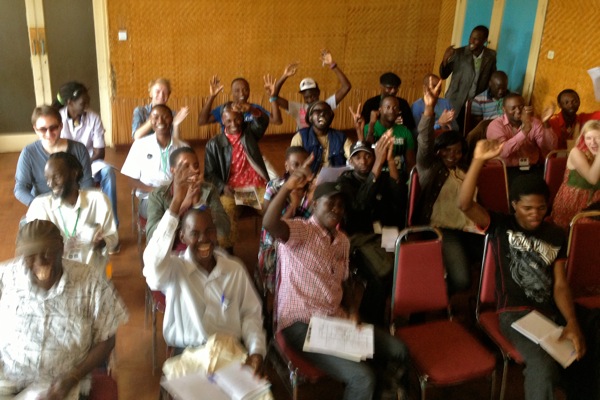
I’ve been very busy the whole time, of course. I swam in the Nile, hiked alongside waterfalls, watched some of the most incredible percussionists I’ve ever seen, danced to one of the best live reggae bands I’ve heard, won hundreds of thousands of shillings at the roulette table (nearly £30), and saw some amazing animals.
I was there with a fantastic bunch of people and have many, many stories to tell…
I also took about 500 photos, which you’re welcome to wade through, if you feel so inclined…
I'm an author of books about technology, culture, music and radio. I'm also an award-winning broadcaster and filmmaker, a public speaker and lecturer, record producer and festival director. I am closely following developments in emerging technologies and the cultures and ethics surrounding them, and my projects typically focus on issues of justice, inclusion, and sustainability.
Most of my work involves surrounding myself with incredibly smart and talented people who would have no other reason to ever be in the same room as each other. That's when amazing things happen.
I tend to talk a lot about music (often jazz-adjacent and particularly on vinyl, but also playlists and mixtapes). I'm enthusiastic about food and cooking, the intersection of art and science, new technologies, vintage technologies, education, social progress, silence, innovation, narrative, data commons, culture, sound art and the spoken word. This blog will continue to reflect those diverse and shifting enthusiasms. I may also digress.
I'm from Tāmaki Makaurau / Auckland in Aotearoa New Zealand, I have Scottish ancestry, I've spent a decade in the south of Birmingham UK, and another in a forest in the north of Sweden.
Contains information related to marketing campaigns of the user. These are shared with Google AdWords / Google Ads when the Google Ads and Google Analytics accounts are linked together.
90 days
__utma
ID used to identify users and sessions
2 years after last activity
__utmt
Used to monitor number of Google Analytics server requests
10 minutes
__utmb
Used to distinguish new sessions and visits. This cookie is set when the GA.js javascript library is loaded and there is no existing __utmb cookie. The cookie is updated every time data is sent to the Google Analytics server.
30 minutes after last activity
__utmc
Used only with old Urchin versions of Google Analytics and not with GA.js. Was used to distinguish between new sessions and visits at the end of a session.
End of session (browser)
__utmz
Contains information about the traffic source or campaign that directed user to the website. The cookie is set when the GA.js javascript is loaded and updated when data is sent to the Google Anaytics server
6 months after last activity
__utmv
Contains custom information set by the web developer via the _setCustomVar method in Google Analytics. This cookie is updated every time new data is sent to the Google Analytics server.
2 years after last activity
__utmx
Used to determine whether a user is included in an A / B or Multivariate test.
18 months
_ga
ID used to identify users
2 years
_gali
Used by Google Analytics to determine which links on a page are being clicked
30 seconds
_ga_
ID used to identify users
2 years
_gid
ID used to identify users for 24 hours after last activity
24 hours
_gat
Used to monitor number of Google Analytics server requests when using Google Tag Manager